
What We Do
Animal Enforcement
& Protection
From livestock to companion animals
Enforcement
Overview of Protection Services
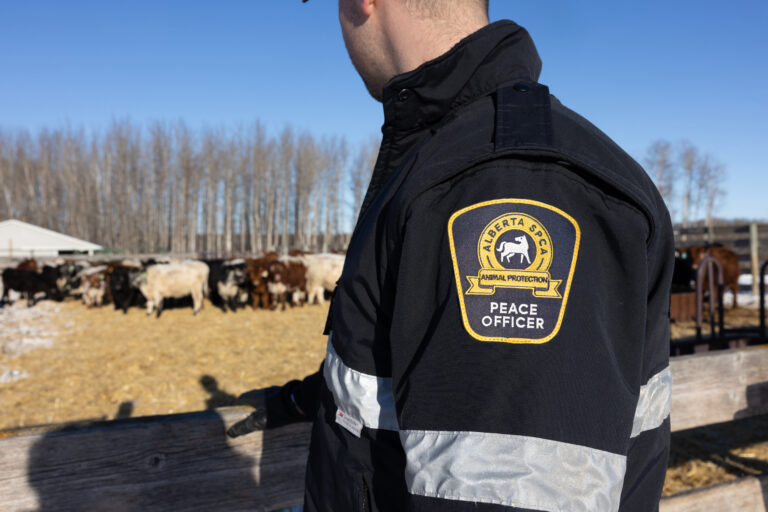
Peace officers at the Alberta SPCA enforce the Animal Protection Act (APA) in all areas of Alberta outside the cities of Edmonton and Calgary. The APA makes it an offense to permit an animal to be in distress.
The Alberta SPCA receives thousands of calls each year from people concerned they have witnessed some form neglect or abuse, leading to distress for the animal. Our team investigates animal welfare issues involving all domestic animals, including companion animals and livestock.
Neglect is the most common animal welfare issue leading to distress. Under the Animal Protection Act, distress is defined as:
- a lack of adequate food and water
- a lack of adequate care when an animal is sick or injured
- a lack of appropriate shelter, ventilation and space
- a lack of reasonable protection from injurious heat or cold
Regardless of the reason for neglect — be it carelessness, oversight or lack of knowledge — people who own or look after animals must be held accountable. In some instances, we work with people to improve their understanding of acceptable levels of care and husbandry, therefore improving the conditions for the animals. However, if an animal owner or caretaker cannot or will not take appropriate steps to relieve distress in their animals, our peace officers have the authority to seize the animals in order to take the necessary steps to relieve the distress. No two investigations are alike and it’s up to our peace officers to use their extensive knowledge and experience to take appropriate action based on what they observe.
When Do We Seize Animals
If our Alberta SPCA peace officers arrive at a property to find animals in distress, our first priority is always to relieve the distress. Often, this means working with the animal owner to understand what the problems are and implementing solutions to improve the conditions. However, if the animal owner is unable or unwilling to make improvements, or the condition of the animals is critical, we may decide to remove the animals. If we are dealing with a herd that contains animals with different levels of health, we may seize only the animals that are in distress. However, if the peace officer feels the other animals on the property are at risk of falling into distress, we may choose to seize them all.
Process to Reclaim Seized Animals
When Alberta SPCA peace officers seize animals, they will post a notice at the former location of the animals stating the reason for the seizure.
Pursuant to Section 7 of the Animal Protection Act, the Alberta SPCA will be entitled to transfer ownership of these animals to new owners, unless the current caretaker takes all of the following steps within 10 days of the date of seizure shown on the attached Notice of Seizure.
Provide written notice to the Alberta SPCA, in the form of email, fax or written letter, of their intention to reclaim the seized animals.
Prove legal ownership of each of the animals listed in the attached Notice of Seizure that they claim to own.
Provide payment to the Alberta SPCA of all expenses claimed by the Alberta SPCA for seizure, transportation, assessment, care and board of the animals up to the date of reclaiming of the animals.
Even if the animal owner or caretaker complies with the above steps, if they have been charged with an offence under the Animal Protection Act, the Alberta SPCA may choose to not release some or all of the seized animals. This process occurs while the Alberta SPCA seeks a custody order under Section 13 of the Act to protect the animals pending trial for the offence. No transfer of ownership of the animals under a custody order will be made until the trial is over.
If the animal owner or caretaker does not comply with the above steps within the 10-day time limit, any ownership interest in the animals will end. Alongside this, no payment for any value of the animals will be made to the animal owner if the costs of seizure, transportation, assessment, care, board and sale exceed the proceeds of any sale of the animals, or if there are no proceeds from sale or other transfer of ownership of the animals.
Investigating Neglect and Abuse
We rely on the public to let us know about any domestic animals that they suspect are being abused or neglected. Our peace officers investigate every complaint we receive about animals in distress. Under the law, we can only investigate if we have reasonable and probable grounds to believe there may have been an offence under the Animal Protection Act. Normally, a call from a neighbour or witness constitutes such grounds for investigation.
If you believe an animal is in distress we ask you to report the situation to our Animal Protection Line at 1-800-455-9003, even if you have called in the past. In the case of livestock as well as pets kept outdoors, the condition of these animals can deteriorate quickly, particularly if they are in poor shape during extreme weather.
Frequently Asked Questions About Investigations
How do you find out about animals in distress?
We rely on the public to inform us if they suspect an animal is being abused or neglected. Most often this is done through calls to our toll-free reporting line 1-800-455-9003.
Why are animals sometimes in very poor shape before anything is done?
Our peace officers investigate every complaint we receive about animals in distress. Under the law, we can only investigate if we have reasonable and probable grounds to believe there may be an offence under the Animal Protection Act. Normally, a call from a neighbour or witness constitutes such grounds for investigation.
If someone has been convicted of animal abuse or neglect, do you monitor them so they don’t repeat their actions?
If someone is found guilty of an offence under the Animal Protection Act, the courts may impose conditions that allow our peace officers to enter the property to check on the well-being of any animals. When such conditions are ordered, we perform regular checks. Without such an order, we must rely on complaints from the public to investigate.
Why are people who are convicted of animal abuse allowed to keep animals?
It’s up to the courts to prohibit someone from owning animals if they have been convicted of an offence under the Animal Protection Act. The Alberta SPCA can put forward a prohibition order request if we believe the guilty person will continue to mistreat animals. The final decision, however, is up to the courts.
What happens to animals that are seized?
Animals that are seized are moved to a caretaking facility. When large numbers of animals are seized, they may be taken to a commercial facility that has the capacity to hold and care for them. After a holding period (specified by the Animal Protection Act), new homes may be found for the animals, or in some cases the animals may be sold.
Who determines the amount of the fine?
If someone is found guilty of an offence under the Animal Protection Act, the court assesses the fine. The maximum fine under the Act is $20,000. In addition, the court may prohibit the guilty party from owning or caring for animals, or limit the number of animals they may own.
If seized animals are sold, who gets the proceeds?
By law, an SPCA or humane society that seizes animals is entitled to recover the expenses incurred in caring for the animal. Under Section 7(4) of the Animal Protection Act, “The balance of the sale proceeds remaining… shall be paid to the former owner of the animal.”
What should the public do if they suspect an animal is in distress?
Anyone who believes an animal is being neglected or in distress is encouraged to call our Animal Protection Line – 1-800-455-9003. We encourage the public to call whenever they have reason to believe animals are in distress, even if they have called in the past. The conditions of animals can deteriorate quickly, particularly if they are in poor shape during extreme weather events.
Recent Convictions & Prohibition Orders
The Alberta SPCA maintains a full list of active prohibition orders in our jurisdiction. At times, we may include prohibitions that were ordered from other jurisdictions, and this will be noted in the description. Additionally, we provide a list of recent convictions resulting from Alberta SPCA investigations.
Our Enforcement Policies
Animal Protection Services Philosophy
The Alberta SPCA’s ultimate objective is to ensure that all animals are humanely treated at every stage of their life. Animal Protection Services staff use a variety of approaches to achieve this objective, including communication, education, monitoring, inspection and enforcement of provincial animal protection legislation.
Goal
The goal of the Alberta SPCA’s Animal Protection Services is for all animal owners to demonstrate compliance. The aim is to achieve, at a minimum, compliant behaviour that satisfies applicable requirements, while encouraging animal owners to exceed the requirements.
Purpose
The purpose of the Alberta SPCA’s Animal Protection Services philosophy is to ensure compliance with the applicable requirements through transparent, fair, consistent and effective processes based on respect, accountability, integrity and excellence.
Basic Principles
- Compliance is facilitated through a good understanding of the purpose and rationale of the specific requirements of any legislation or standard. There is an obligation to clearly describe the desired outcome or requirement in the legislation. The requirements may be further clarified in a standard or guideline. There is an obligation on the Alberta SPCA’s part to inform and educate animal owners and users about the requirements, means of compliance and, where possible, opportunities to go beyond compliance to best practices.
- The approach to compliance will be based on the severity of distress. While, by definition, compliance is required, the speed of coming into compliance, and the appropriate immediacy of a compliance response will depend on the level of distress. The immediacy, scope and severity of the situation will determine the appropriate response.
- Compliance tools will be deployed in a logical sequence of steps, with the starting point and speed of progression based on severity of distress. The approach will be graduated, unless the distress level requires timely progression to more immediate tools.
- The approach to compliance will take into account the animal owner’s/user’s previous record of compliance, or beyond compliance, behaviour.
- The Alberta SPCA has an obligation to assess overall compliance and will use monitoring activities as appropriate for the level of distress associated with the specific circumstances.
- Responding to public complaints is part of the Alberta SPCA’s Animal Protection Services program. Each complaint will be assessed and investigated, and the appropriate action taken to resolve the complaint. Complainants will be advised upon resolution of the investigation.
- Prosecution is a tool of compliance, not a goal. The Alberta SPCA does not set out to prosecute, but will proceed to prosecution if it is necessary to address willful or repeated contravention, if the offence has a high severity of distress or if the demonstrated value of the prosecution will promote broader awareness and compliance.
- Prosecution will be evidence-based, following a documented investigation and review by a Justice. The evidence and the severity of the impact will be assessed.
Receiving Animal-Related Complaints
Most Alberta SPCA investigations originate from a complaint alleging animal neglect or abuse. Animal-related complaints may be submitted by telephone, in writing, in person or from another agency. Most commonly, the complaint is received by telephone through central dispatch. Upon receipt, all information is entered into the Animal Protection Services database, prioritized and assigned to a peace officer for investigation.
Occasionally, complainants are reluctant to give their names. Anonymous complaints are responded to and are not discouraged, although investigations may require contacting the complainant for further details (e.g., if the peace officer is unable to locate the animal from the directions given).
Seizure of Animals
Section 3 of the Animal Protection Act gives authority for an Alberta SPCA peace officer to seize or take custody of animals. Animals found in distress and not likely to be relieved of distress will be placed under seizure and removed from the property.
Public Communication and Confidentiality
As an enforcement agency, the Alberta SPCA collects and records confidential information regarding a number of individuals, including the subject, complainant and others associated with the investigation of a complaint. Under Canada’s Personal Information Protection and Electronic Documents Act (PIPEDA) and Alberta’s Personal Information Protection Act (PIPA), the Alberta SPCA is legally required to safeguard the personal information that it collects.
Although complainants are entitled to be informed of an investigation’s final outcome, peace officers can’t reveal specific details of the investigation.
Animal Care Standards
The interpretations of the care duties under the Animal Protection Act can sometimes be ambiguous.
Food
Food should be wholesome, palatable and free from contamination. It must be provided in sufficient quantity to be of adequate nutritional value to maintain the animals in good health. The diet must take into consideration the age, species, condition, size and type of animal. Animals should be fed at least once in every 24-hour period, except as dictated by veterinary advice or other professionally accepted practices for the well-being of the animal. If more than one animal is fed at one time or in one place, it is the responsibility of the owner or user to ensure that each animal receives adequate nutrition.
Water
Adequate water means access to palatable water of adequate quality and quantity to fulfill physiological needs. Exceptions may be determined by veterinary consultation or professionally accepted practices for the well-being of the animals. Animals that are being worked or transported must be provided water as often as necessary for the health and comfort of the animals. Frequency of watering must consider the age, size, species, condition and type of animal. Activity levels, lactation and weather conditions must also be considered. All water receptacles should be of appropriate design and size for the animal, and be positioned or affixed to prevent spills.
Shelter
Outdoor Shelter: All animals kept outdoors must have access to shelter that provides protection from the weather. Shelter must be appropriate for the species, with consideration for the animals’ age, physical condition and hair coat when determining whether or not available shelter is adequate. Animals require shelter from wind in cold weather conditions and shade from the sun during hot weather.
Indoor Housing: Facilities must be sufficiently regulated by heating and cooling to protect animals from extremes of temperature and to provide for their health and well-being. Closed facilities should be adequately ventilated by natural or mechanical means to provide for the health of the animal at all times.
Space: All enclosed animals must be able to stand to their full height, stretch out, lie down, and make normal postural adjustments comfortably. Animals must be allowed to exercise and have freedom of movement, as necessary, to reduce stress and maintain good physical condition. Space available to an animal must be usable and maintained in a safe and healthful manner. It must be free of accumulated waste and debris.
Veterinary Care
Veterinary care must be provided to any animal found in distress as a result of an injury or medical condition requiring treatment.
Inspections
Animal-holding facilities and vehicles used to transport animals must meet animal welfare standards that ensure animals are not exposed to distress situations. Regular inspections or as designated by the Director of Animal Protection Services are required to ensure animal welfare standards are being met.
Section 10 of the Animal Protection Act authorizes Alberta SPCA peace officers to inspect any animal-holding premise, other than a private dwelling house, where animals are kept for sale, hire or exhibition or any vehicle used in transporting animals.
Educational Material
Education of animal owners and users plays a key role in preventing animal neglect and mistreatment. In their daily interactions with the public, Alberta SPCA staff members have opportunities to provide education about the humane care and treatment of animals. Appropriate educational material can help the animal owner/user to improve animal husbandry practices.
Uniforms and Identification Cards
Peace officers need to present a formal appearance with standardized clothing that conforms to Alberta SPCA requirements. They also need to carry identification that identifies them as peace officers. Peace officers will wear their uniforms at all times during the performance of their Animal Protection Services duties. Peace officers will carry their Peace Officer ID, issued by Alberta Solicitor General and Public Security, at all times while on duty.
Informal Resolution of Complaints Against Peace Officers
The Director of Animal Protection Services will accept and investigate public complaints regarding the administration of the Animal Protection Services Program, and work with the Executive Director of the Alberta SPCA to resolve the complaints.
If for any reason members of the public believe they may have been treated unjustly or unfairly by the Animal Protection Services Program, they may lodge a formal complaint as follows:
- Submit a written outline of the nature of the concern to the Director of Animal Protection Services within 60 days of the alleged incident.
- Supply the Director of Animal Protection Services with any written or material evidence and/or names of witnesses, etc. that may shed further light on the issue.
- Meet with the Director of Animal Protection Services and/or the Executive Director to attempt a resolution of the issue.
- Failing resolution at this point, full disclosure is made to the Alberta SPCA Board of Directors, which has sole discretion in determining final resolution of the issue in question.
The Director of Animal Protection Services will investigate the complaint and then meet with the complainant and the Executive Director to attempt to resolve the complaint. If they cannot resolve the complaint, they turn the matter over to the Alberta SPCA Board of Directors. The decision of the board is final, with the exception of a prosecution matter, which is resolved through the judicial process.
Legislation
The Animal Protection Act
Alberta’s Animal Protection Act provides mechanisms to help domestic animals that are in distress, and to hold negligent owners or caretakers accountable for their actions. This primary piece of legislation, amended in 2006, is used to protect animals in Alberta.
Key aspects of the act include:
- a definition of distress
- detailed list of duties that must be performed by animal care providers
- powers of peace officers
- prohibition against abandoning animals
There are also provisions in the associated regulations that incorporate standards for animals used in research and higher education.
Definition of Distress
The Act states an animal is in distress if it is:
(a) deprived of adequate shelter, ventilation, space, food, water or veterinary care or reasonable protection from injurious heat or cold,
(b) injured, sick, in pain or suffering, or
(c) abused and subjected to undue hardship, privation or neglect.
The provisions for ventilation and space mean that animals kept in holding facilities are entitled to fresh air and sufficient room to carry out normal activities. The term “veterinary” is used to clarify the type of care, and to ensure that animals receive proper medical attention when needed.
The requirement for reasonable protection from injurious heat or cold makes it an offense to fail to protect animals from extreme temperatures. The type of protection varies according to species, and sometimes by breeds within a single species. However, all species require some form of protection from the elements. Dogs left outdoors, for example, need a degree of protection dependent on their breed hardiness. Some livestock species such as pigs require enclosed structures, while windbreaks are acceptable for cattle and horses.
Animal Care Duties
The Act delineates the duties that must be carried out by anyone who owns or looks after an animal – i.e., they must:
(a) ensure that the animal has adequate food and water,
(b) provide the animal with adequate care when the animal is wounded or ill,
(c) provide the animal with reasonable protection from injurious heat or cold, and
(d) provide the animal with adequate shelter, ventilation and space.
This section was created as part of the amendments to the Act in 2006 and corresponds to the expanded definition of distress. By placing the duties in positive terms, it clearly defines the responsibilities of an animal owner and presents them in comprehensive terms. Rather than having to prove an animal is in distress, failure to perform these duties is now enough to be considered an offense. For instance, it’s much easier to see that an animal is not being given water to drink than to show that it is in distress from dehydration.
Powers of Peace Officers
The Act allows our peace officers to take an animal into custody or otherwise relieve them of distress if the officer is of the opinion – on reasonable and probable grounds – that the owner or caretaker is not likely to provide for the animal.
For example, if a dog is left outside with no doghouse or other protection from extreme weather and the forecast calls for -30°C the next day, peace officers can remove the dog and take it to a shelter before it is subjected to the bitter cold. This allows our peace officers to take a proactive approach to ensure animals do not become in distress.
Prohibition Against Abandoning Animals
A peace officer can take an abandoned animal into custody – whether or not it’s in distress. The conditions that comprise abandonment include being left for more than 24 hours without adequate food, water or shelter, or being left behind by former tenants of a rental property.
Other Features of the Animal Protection Act
This Act allows those who report suspected animal distress to be free from prosecution. It disallows any action from being taken unless the report was made maliciously or without probable grounds for the belief.
The regulations associated with the Act incorporate parts of other provincial statutes that deal with animal welfare. This includes parts of the Livestock Transportation Regulations, the Livestock Market and Assembly Regulations, and the Motor Vehicle Act. The Regulations also include the standards set by the Canadian Council on Animal Care (CCAC) which oversees the treatment of animals used in research and post-secondary education facilities.
The complete text of the current Act and Regulations are available through the Alberta Queen’s Printer at the following links:
Other Laws
Criminal Code of Canada
The Criminal Code of Canada contains two sections that make it an offense to willfully permit or cause unnecessary pain, suffering or injury to an animal, or to utter a threat to kill or injure an animal. Penalties under the Criminal Code can include jail time.
The sections of the Criminal Code that are specific to animals are:
Animal Transport Regulations
The Health of Animals Act ensures livestock in Canada are fit for transportation and are treated humanely.
The regulations are set out on the Government of Canada’s website. Information on whether an animal is fit for transportation can also be found on the CFIA’s website.